Saturday, October 9, 2010

Sprouted Lentils

You've seen bean sprouts in your stir fry and sunflower sprouts in your salad, but most people don't realize that just about every grain, bean, and seed sprouts.

Sprouting essentially takes a dormant seed and creates a live plant. Sprouting neutralizes phytic acid and enzyme inhibitors. Phytic acid binds with calcium, magnesium, iron, copper, and zinc, making it hard to impossible for you to absorb those nutrients. Enzyme inhibitors inhibit enzymes (surprise surprise) in the seed and your own digestive enzymes from doing their job.


All in all, sprouting makes grains, seeds, and legumes (beans) easier to digest and you will be able to assimilate more nutrients.


More reasons sprouting rocks here!


How To Sprout:
The method is pretty much the same for most seeds, grains, nuts, and legumes, it’s just the time that varies. 
  1. Fill a mason jar about one third full of desired seed to sprout, and then fill the mason jar with water and soak overnight.
  2. Cover the mason jar with a sprouting screen screwed into the lid. You can use any sort of material that allows water out but keeps the sprouts in (make-shift one out of a screen?).
  3. In the morning you drain the jar and rinse it right through the screen, and then you invert your jar at an angle, allowing it to drain and air to circulate within your jar.
  4. All you have to do now is rinse 2-3 times per day, and your seeds will turn into sprouts!
I take this process to a whole new level of easiness (laziness...) and I get sprouts every time so I think it's an A-OK method:


Marcy creeping on my lentil sprouts
  1. Fill a container (mason jar, tupperware container, wine glass...) about 1/3 of the way full with desired grain, legume, or seed and fill up with water.
  2. Soak overnight.
  3. In the morning, pour out water while holding the goods in the container with your hand.
  4. Pour more water in, swish around and dump water out again.
  5. Repeat step 4 2-3 times per day to keep the goods damp and prevent mold from growing.
Once sprouting process is complete (see the chart below), dump the sprouts onto a paper towel and allow them to dry before storing them in the fridge.
Nuts do not grow tails but it's important to soak (or roast) raw nuts to get rid of the enzyme inhibitors.


Soaking and Sprouting Times


Nut / SeedDry AmountSoak TimeSprout TimeSprout LengthYield
Alfalfa Seed3 Tbsp12 Hours3-5 Days1-2 Inches4 cups
Almonds3 Cups8-12 Hours1-3 Days1/8 Inch4 Cups
Amaranth1 Cup3-5 Hours2-3 Days1/4 Inch3 Cups
Barley, Hulless1 Cup6 Hours12-24 Hours1/4 Inch2 Cups
Broccoli Seed2 Tbsp8 Hours3-4 Days1-2 Inches2 Cups
Buckwheat, Hulled1 Cup6 Hours1-2 Days1/8-1/2 Inch2 Cups
Cabbage Seed1 Tbsp4-6 Hours4-5 Days1-2 Inches1 1/2 Cups
Cashews3 Cups2-3 Hours4 Cups
Clover3 Tbsp5 Hours4-6 Days1-2 Inches4 Cups
Fenugreek4 Tbsp6 Hours2-5 Days1-2 Inches3 Cups
Flax Seeds1 Cup6 Hours2 Cups
Garbanzo Beans
(Chick Pea)
1 Cup12-48 Hours2-4 Days1/2-1 Inch4 Cups
Kale Seed4 Tbsp4-6 Hours4-6 Days3/4-1 Inch3-4 Cups
Lentil3/4 Cup8 Hours2-3 Days1/2-1 Inch4 Cups
Millet1 Cup5 Hours12 Hours1/16 Inch3 Cups
Mung Beans1/3 Cup8 Hours4-5 Days1/4-3 Inches4 Cups
Mustard Seed3 Tbsp5 Hours3-5 Days1/2-1 1/2 Inches3 Cups
Oats, Hulled1 Cup8 Hours1-2 Days1/8 Inch1 Cup
Onion Seed1 Tbsp4-6 Hours4-5 Days1-2 Inches1 1/2-2 Cups
Pea1 Cup8 Hours2-3 Days1/2-1 Inch3 Cups
Pinto Bean1 Cup12 Hours3-4 Days1/2-1 Inch3-4 Cups
Pumpkin1 Cup6 Hours1-2 Days1/8 Inch2 Cups
Quinoa1 Cup3-4 Hours2-3 Days1/2 Inch3 Cups
Radish3 Tbsp6 Hours3-5 Days3/4-2 Inches4 Cups
Rye1 Cup6-8 Hours2-3 Days1/2-3/4 Inch3 Cups
Sesame Seed,
Hulled
1 Cup8 Hours1 1/2 Cups
Sesame Seed,
Unhulled
1 Cup4-6 Hours1-2 Days1/8 Inch1 Cup
Spelt1 Cup6 Hours1-2 Days1/4 Inch3 Cups
Sunflower, Hulled1 Cup6-8 Hours1 Day1/4-1/2 Inch2 Cups
Teff1 Cup3-4 Hours1-2 Days1/8 Inch3 Cups
Walnuts3 Cups4 Hours4 Cups
Wheat1 Cup8-10 Hours2-3 Days1/4-3/4 Inch3 Cups
Wild Rice1 Cup12 Hours2-3 DaysRice Splits3 Cups

Curried Lentil Sprouts with Cilantro-Garlic Sauce
Based off of recipe by The Nourishing Gourmet. I personally don't like cilantro so I wasn't too keen on the sauce but luckily the curried lentil sprouts taste awesome on their own.


Ingredients:
-for lentils-
3 c lentil sprouts
1 small onion, chopped
3 cloves of garlic, minced
2 T olive oil
1 T curry powder
0.5 t ground cloves
-for sauce-
1 bunch of fresh cilantro
2 cloves of garlic, minced
1 inch of fresh ginger, peeled and chopped
2 T olive oil
1 small hot pepper, seeds removed
1 t salt
Juice from 1/2 of a lemon*

Directions:
Mix lentil ingredients together in a bowl.
Food process sauce ingredients until smooth pesto-like consistancy.

*I omitted the lemon juice because there aren't any lemons growing in Michigan (I miss them already...)

Thursday, October 7, 2010

October Birthday Feast

Last night, in honor of my lovely roommate, Marcy, and in celebration of her 20th birthday, I cooked up a harvest feast. Probably not the most logical use of my time considering I have a physics exam tomorrow but hey, we all have our vices.

Say "Hello," Marcy!

The following recipe is based off of a recipe from the food blog Sprouted Kitchen. I highly recommend perusing the Sprouted Kitchen archives because not only are the recipes delicious but the pictures that highlight the ingredients and dishes will make you drool and fall in love with food all over again.

Spiced Sweet Potatoes and Chickpeas


Ingredients:
2-3 large sweet potatoes
1 c chickpeas (AKA garbanzo beans), soaked overnight*
3 small onions
3 T olive oil
1 t cinnamon
2 T honey
2 t nutmeg (I didn't have any so I used ground cloves...)
1 inch fresh ginger, grated
2 garlic cloves, minced (I used about 4 cloves but that's because I am a garlic fiend)
1 t cayenne pepper (optional)
1 t salt
Juice and zest of 1 lime
Ground pepper
Rosemary and/or thyme

Directions:
Preheat oven to 425
Bring 3 cups of water to a boil and add soaked chickpeas. Reduce to a gentle boil and cook for an hour, or until chickpeas are soft. Drain.
While the chickpeas are cooking, peel and dice sweet potatoes into 1 inch cubes.
In a small bowl, whisk together the olive oil, cinnamon, honey, nutmeg, ginger, cloves, salt, and lime juice.
Pour over sweet potatoes and stir. Add drained chickpeas and onions and about 2 T of dried rosemary and stir.
Dump the mixture onto a baking sheet and cook for 35-40 minutes or until the sweet potatoes are tender, stirring halfway through.
Remove from oven and season with salt and pepper to taste. If any lime juice is left over, squeeze over the dish.

*I used a 16 oz. can of chickpeas from my pre-challenge stash


Golden Brussels Sprouts with Roasted Almonds


Ingredients:
Brussels sprouts
olive oil
salt
pepper
almonds, chopped

Directions:
Remove unsightly leaves from Brussels sprouts and cut in half lengthwise. Toss with about 1 T olive oil.
Heat 1 T oil over medium heat and add Brussels sprouts. Cook until golden brown, stirring occasionally.
Roast almonds over medium-low heat until golden brown and fragrant, stirring often.
Mix Brussels sprouts and almonds.
Season with salt and pepper to taste.

Wednesday, October 6, 2010

Feeling hot hot hot


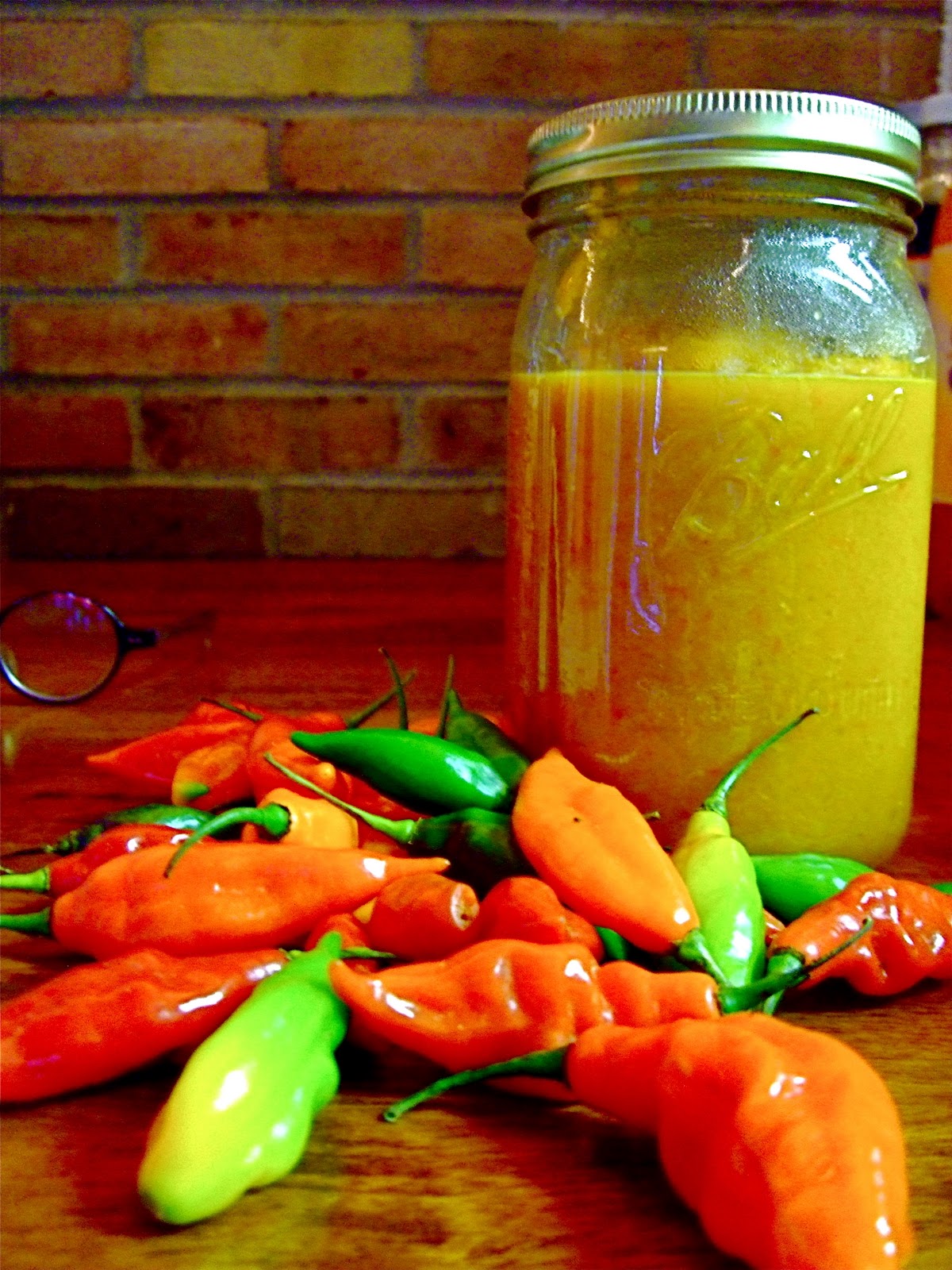
At the Farmer's Market the other day I was drawn to a table full of hot peppers. The vibrant colors were reminiscent of the summer heat, plus I could not pass up an opportunity to make hot sauce...

Habanero Hot Sauce
Ingredients:
0.5 large red onion
3 cloves of garlic, minced
1 T oil
2 carrots, chopped
1/8 c water
12 Habanero peppers, stemmed and seeded, chopped
(If you want it hotter, do not seed it. But believe me, it's hotttt)
0.5 c white vinegar
Juice of a lime*


Directions:
Heat oil over medium-low heat. Add onion and garlic and saute until soft but not brown.
Add carrots and water and bring to a boil. Cover and reduce heat to low. Cook until carrots are soft.
Chop peppers in a food processor (or blender). Transfer carrot mixture to the food processor and blend until smooth.
Mix in vinegar and lime juice and transfer all back to stovetop.
Simmer hot sauce for 5 minutes and pour into sterilized containers for storage.

WARNING: Hot peppers are a natural source of capsaicin, an irritant that produces a sensation of burning on any tissue that it comes into contact with (hence them being spicy). Wash your hands after handling the peppers but if you are still burning like I was, apply rubbing alcohol (capsaicin is soluble in alcohol) to your skin and follow with oil or aloe.


*From my pre-challenge stash. I am not quite sure what I will do when they are gone but I will worry about that when the time comes...

Monday, October 4, 2010

Go veg

"Nothing will benefit human health and increase the chances of survival of life on earth as much as the evolution to a vegetarian diet."
- Albert Einstein


As may have been noted from past posts, I am a strict vegetarian. I do not eat the flesh or secretions of animals (i.e. no meat, dairy, eggs). Surprisingly enough, it was not environmentalism that led me to vegetarianism but vegetarianism that led me to environmentalism.


Nutrition was my personal reason for cutting animals out of my diet, I truly believe that a purely plant-based diet is the healthiest for my body. However, that is a different subject altogether. Today I want to talk about the environmental benefits of going vegetarian.

Fun facts:
  • Studies on world food security estimate that a diet containing meat requires up to 3 times as many resources as a vegetarian diet.
  • According to the Water Education Foundation, it takes 2,464 gallons of water to produce 1 lb of beef in California. This is the same amount of water you would use if you took a 7-minute shower every day for 6 months. In contrast, only 25 gallons of water are needed to produce 1 lb of wheat. 
  • According to the Rainforest Action Network, 55 square feet of tropical rainforest are destroyed to make every fast-food hamburger made from rainforest cattle.
  • The United Nations reported in 2006 that eating meat causes almost 40% more greenhouse-gas emissions than all the cars, trucks, and planes in the world combined.
  • Farmed animals produce about 130 times as much excrement as the entire human population of the US. Since factory farms don't have sewage treatment systems as our cities and towns do, this concentrated slop ends up polluting our water, destroying our topsoil, and contaminating our air.
  • The average fossil fuel energy input for all the animal protein production systems is around 25 kilocalories (kcal) per 1 kcal of protein produced. That's more than 11 times greater than that for grain protein production.
  • A diet that is healthy, vegetarian, local and organic could reduce the UK food footprint by 44% per capita.


I have heard time and time again how people could never give up this or that, but the message that I really want to send out is not that everyone must become a vegetarian but instead to be more conscious of the choices that you are making. You don't need to be a vegetarian to enjoy a vegetarian meal, and the more of those that you eat, the less of an impact that you are making.


When you do choose to eat meat, eggs and/or dairy, buy from local, organic, grass-fed sources. Yes, it will be more expensive but hey, that may be enough of an incentive to eat fewer animal products!

Sunday, October 3, 2010

A morning of pizzas

Yesterday I made another journey to the Farmer's Market and thanks to Poonam's access to a car, I was a little overzealous with my purchases. Having not even gotten through the produce from the week before, I still bought a bushel of tomatoes (which I blanched, pureed, and froze for use later in the year in the wee hours of the night). Needless to say, it's time for me to cook. Or as I did this morning, bake!

I made an heirloom tomato pizza and a pesto-arugula pizza, however since they don't have cheese on them, they may be deemed flatbread.


Whole Wheat Pizza Dough

Serving Size: 1 large pizza, about the size of a large baking pan

Ingredients:
2.5 c whole-wheat flour (local, bought in bulk from PFC)
0.25 t baking powder
0.5 t salt
1 c water
0.5 c oil (I used olive oil)
garlic granules (optional)
rosemary or any other herbs that you like (optional)

Directions:
Whisk together dry ingredients and wet ingredients separately. Combine in a large bowl and mix until dough forms.
On a floured surface, knead dough for 5 minutes. Cover and let rest for 30 minutes.
Sprinkle corn meal (or flour) onto a large baking pan. Roll out dough until about the size of the pan and transfer over to pan. Poke holes into the dough with a fork.

Heirloom Tomato Pizza


Ingredients:
whole wheat pizza dough
oil (I used canola oil)
0.25 large red onion, sliced into half moons
5 cloves of garlic, sliced
2-3 heirloom tomatoes, thinly sliced
olive oil
salt
pepper
rosemary or any other herbs that you like

Directions:
Bake pizza dough in oven at 400 degrees for 10-12 minutes, or until it starts becoming golden brown.
Remove from oven and increase temperature to 425 degrees.
Drizzle dough with oil and spread so that the surface is covered. Sprinkle garlic and onion onto the dough. Bake for 10 minutes.
Remove from oven and arrange slices of heirloom tomatoes onto the crust so that it makes a complete layer. Return to oven for 5 more minutes.
Remove from oven. Drizzle with olive oil and sprinkle salt, pepper, and rosemary to taste.
Cut into slices and serve!

Green Pizza


Ingredients:
whole wheat pizza dough
0.5 c pesto (recipe below)
1 T canola oil
1 bunch arugula, chopped and stems removes
olive oil
salt
pepper


Directions:
Bake pizza dough at 450 degrees for 10-12 minutes on the lowest rack of your oven.
While the dough is baking, heat canola oil in a skillet over medium heat and add arugula. Sautee for about 2 minutes, stirring constantly until the arugula is wilted.
Remove crust from oven and spread pesto onto the crust. Distribute arugula onto the pizza.
Bake pizza for 10 more minutes.
Remove from oven. Drizzle with olive oil and sprinkle salt and pepper to taste.
Cut into slices and serve!

*This recipe would be good with any sort of grilled/sauteed veggies. Get creative!

Basil-Almond Pesto
Ingredients:
2 bunches of fresh basil (about 3-4 packed cups)*
1/3 c almonds, sliced**
2 heaping T white miso
1/3 c olive oil
Juice of 1/2 lemon or 1 lime
3-4 cloves of garlic, minced

Directions:
Toast almonds in a saute pan over medium heat until golden brown and fragrant.
Food process (is that a verb?) almonds and garlic until chopped. Add miso and pulse until incorporated. Add basil and process until chopped and even consistency. Add oil and lime juice and process until smooth.

This makes a solid amount of pesto which can sometimes be dangerous since it becomes discolored if you do not use it quickly. A method that I got a kick out of is freezing the leftover pesto in an ice cube tray and then transferring the frozen pesto cubes to a ziplock bag. This way you freeze small serving sizes and don't have to thaw a big block of pesto every time a recipe calls for a tablespoon or two. Pretty cool!


*Basil can be replaced with cilantro, parsley, spinach, etc. depending on what you have/what you like.
**Pesto is traditionally made with pine nuts but those are pretty expensive (and I can't find them in bulk). Any sort of nut (walnuts, pecans, cashews...) can be subbed in for the same feel.

Friday, October 1, 2010

Pickle Party

September 1st was a day of pickle making and today, October 1st, one month later is a day of pickle eating!

Hadas and Marcy and the pickles! Hurray!

Our patience has been well rewarded and we finally get to enjoy the fruits of our labor!
Thanks Teddy for your wisdom and family recipe